
Insurance and Liability
This module is designed to guide you through the key agribusiness topics of insurance and liability. We encourage you to visit the sections most relevant to you using the hyperlinks below.
Introduction
Liability
Must Read Articles
Resources and Support
Disclaimers
References
Key Take Aways
- Prevention is your best protection. Accidents can invariably occur on the farm, but being proactive to mitigate your risks is one of the most important things you can do.
- Having the right insurance coverage is essential. Work with an insurance agent to determine the types of coverage you need for your specific operation.
- Having one insurance carrier with multiple policies is usually an advantage to having multiple carriers with one or more policies. Otherwise, there is a risk in “who will pay for what” should you have a claim.
- Having the right insurance carrier, the right agent, and the right policies are critical to your peace of mind and minimizing the risks of lawsuits. Choose an insurance carrier with experience in agritourism as the insurance policies and coverages can be very specific and need to be tailored to your operation. Work with an agent that you like, trust, and have an honest working relationship with.
- Meet with your insurance agent each year before your season begins. Do a walk-through of your operation. Use the Insurance Discussion Sheet in our Resources section as a guide.
- Keep your insurance agent informed of any changes in your operation during the year. If you add new structures or activities on the farm, your insurance needs may change.
- Keep good records. Document the proactive safety measures you take on the farm, including the servicing of equipment and training of employees, as well as any injuries that occur on the farm. Once you start keeping records, make sure to maintain them. This becomes more difficult to do as the season gets busier, but it is important to maintain your recordkeeping.
- You have some level of responsibility for the safety of anyone that enters your property. This includes your customers and delivery persons, but also trespassers who may enter your property without your knowledge. Generally, if you aren’t actively trying to harm those individuals, you have very low risk, except when those trespassers are children, as outlined in the Michigan Trespass Liability Act.
- Your highest level of responsibility is for those you invite to the farm, including employees, customers at your market, visitors to your agritourism activities and people coming to your farm for commercial reasons. You are obligated to proactively search for hazards and take efforts to protect visitors from being harmed.
- You have some level of protection against liability from the Michigan’s Natural Resources and Environmental Protection Act, the Michigan Trespass Liability Act of 2014. Still, it’s important to familiarize yourself with the Duty of Care for the different types of visitors who come to your farm.
- There are other laws and practices that can provide an additional layer of protection, such as Limited Liability Laws, Premises Liability Laws, Notices and Waivers, and Posted Signage and Warnings. At present, Michigan does not have a Limited Liability Law or Premises Liability Law, although efforts are being made to enact legislation.
- There are many actions a farmer can take to limit potential liability for injuries to visitors on the property.
- Your best protection is a good insurance policy along with “layers” of protection that demonstrate a proactive, responsible, and comprehensive approach to farm safety.
INTRODUCTION
Why Insurance and Liability Are Important
Agritourism is a growing industry with fewer safety regulations in place than found in other industries. That leaves most of the responsibility for safety to the farmer. When farmers expand from agriculture into agritourism and “farm hospitality”, many find they need additional guidance. There is a lot at stake when incidents occur – it can affect the farmer, the staff, the business itself, and even the community.
Are you prepared for incidents or accidents that may occur on your farm which may result in a customer claim or lawsuit? Although it’s hard to think about something like this happening on your farm, it is a real risk when running a farm that is open to the public. There are ways to protect your assets – most importantly – being aware of potential risks and being proactive in mitigating those risks, having the right insurance policy that covers the many aspects of your business and knowing and following all legal obligations and duty of care to everyone who comes to your farm.
The Importance of Prevention
As outlined in Module 65, Safety and Risk Management, it’s essential to mitigate your risks. Still, unintended injuries may still occur.
Here’s some reminders from Module 65:
- What activities do I offer?
- What could hurt someone?
- What could damage my property?
- Could food make someone sick?
- Do employees create additional risk?
- Have I told my insurance company everything?
What causes lawsuits?
- Slips and falls
- Animal injuries
- Hayrides
- Foodborne illness
- Parking lots
- Children wandering
- Employee mistakes
Every injury you prevent is one less insurance claim and one less unhappy customer sharing negative views about their visit to your farm. Remember: Everything starts with prevention, but following good safety practices without insurance is risky. Similarly, insurance without good safety practices may not protect you. Knowing the law helps you avoid costly mistakes. Together, Risk Management and Insurance are essential to protect your farm and help you avoid claims, higher insurance, legal fees and potential lawsuits.
INSURANCE
If you are an agritourism farmer, you need insurance to protect your farm. You can do everything possible to keep your farm safe for visitors, but invariably, things could still occur and a good insurance policy is the best protection for your farm assets.
There are two broad types of policies – farm and commercial. You may need both types to insure your agritourism operation. Commercial policies are written when the risks become greater than those found on a typical farm, such as when a large portion of on-farm income is in retail sales or there is production of products or goods for a retail market(s).
Insurance is Essential for Agritourism Farms
Farmers need insurance to protect their land, their crops, their buildings, themselves and their employees. Farms that are open to the public need additional insurance to protect against potential claims or lawsuits that result from accidents or injuries that happen on the farm. Each year, a variety of incidents occur at agritourism farms, such as twisted ankles, bee stings, and broken windshields, but sometimes, much more serious things can occur, like a head injury, or a food-borne illness.
There are different types of insurance to cover different aspects of your business and it’s important to work with an insurance agent who can assist you in choosing the right type of insurance for your operation, tailored to the specific agritourism activities being offered at your farm.
How your business is structured can impact your insurance and liability. Small farmers operating as sole proprietors rather than as a separate LLC or corporation are personally liable for injuries on the farm. Your insurance agent will guide you to the type of policies that best suit your needs.
Working with Your Insurance Agent
Obtaining Insurance
The following information and questions are designed to provide basic guidance for getting started and meeting with your insurance agent. These items can be used to start the discussion but are not inclusive, there may be more questions, depending on your operation.
1. Select an insurance provider and agent
- Does the insurance company cover agritourism activities?
- Does the agent have experience working with both agriculture and agritourism clients?
- What experience does the agent and the company have with insuring agritourism? What is the company’s A.B.
- Best Rating? (a measure of financial strength)
- Are you comfortable interacting with the agent? Is the individual well known and respected, understands agriculture and businesses, and will work with you to reduce your potential for risk?
2. View and discuss your specific needs
The agent needs to assess your risks and what you need to protect yourself, your family, and your business. This involves taking a close look at your unique situation and exposures. And the best way to do this is to walk the property, talk about your current coverage, and assess your insurance needs going forward.
- Don’t be secretive about what you’re doing in your operation. Share all activities with the agent. Don’t be uninsured or underinsured simply because the topic(s) didn’t come up.
- Discuss your current coverage levels, limits, and types of coverage, especially those when having guests on the farm, and any additional coverage you need. Find out what it will cost.
- What is the property or liability exclusions or limits in your agritourism policy?
- Discuss the types of coverage appropriate for the operations (like general business liability, umbrella, etc.).
3. Review policy recommendations.
- Ensure that the major agritourism activities are covered by the policy. If an activity is not covered or will require costly additional coverage, weigh the risks, costs, and benefits of continuing to offer the activity.
- What does your policy cover and exclude? Do you also need commercial insurance to maximize your coverage?
- Review quotes for various levels of coverage. What can your farm afford? What level of risk is acceptable to you?
- Decide on an insurance strategy, such as obtaining coverage with a single company having multiple policies or separate companies and policies.
- Use strategies to transfer risk to other parties when appropriate such as when a third party offers a service or activity on the farm. They will need proof of adequate insurance and name the farm/operator as an additional insured. Be sure to have a written contract also.
4. Updates and periodic reviews
- Revisit your farm and personal insurance policies after major life events and any key changes to your farm.
- Revisit your policy whenever there are changes to your agritourism operations and activities. This includes new or discontinued activities, as well as changes in attendance numbers. Avoid the risk of having a claim denied because an activity type is not specifically included in the farm’s insurance policy.
- Know your insurance policy, especially term dates, limits, and exclusions.
- Review your policy and coverage with your agent before starting your season or at least once a year.
5. Keep adequate farm and operational records.
- Document all safety measures taken to demonstrate that the agritourism operation took all reasonable precautions.
- Document the presence and servicing of all safety equipment, training sessions, improvements to make the premises and activities safe, injuries and emergencies, and all other things that your insurance agent requires a record of or recommends.
- Are you following any state law liability requirements? Are you in compliance with other regulations specific to your areas of agritourism operation?
Sources: Rutgers University Extension, Safe Agritourism.org, and Farm Bureau Financial Services
What Insurance Coverage Do Most Agritourism Farms Need?
There are many types of insurance available for both the business and the operators (personal). Here is a breakdown:
Essential Coverage:
- General liability insurance protects agritourism operators from liabilities that may occur due to injuries or damage to customers’ properties. It can pay for slips and falls and medical bills.
- Commercial Property insurance can protect agritourism businesses from damages to the physical properties of the farm like damage to buildings, fires, indoor and outdoor fixtures, fences, signs, lightning, hail, weather-related damage, and others. The insurance protects your buildings, equipment inventory, and outdoor items.
- Farm insurance covers barns, rental housing, equipment, animals, and other farm assets.
- Product Liability insurance protects the business from claims arriving out of the products they sell or serve to customers. Product liability insurance will protect you and pay for damages should you be sued.
- Workers’ Compensation insurance provides for employees in the event of occupational injury or illness. For example, the insurance may cover medical bills, rehabilitation, a percentage of lost wages, and compensation of benefits paid to beneficiaries if an employee is killed on the job.
- Commercial auto insurance covers vehicles used for farm operations. There are several forms of coverage under commercial auto insurance. Auto liability coverage may cover medical and legal expenses if an employee is at fault in an accident or damages another person’s property. Collision and comprehensive coverage reimburse for repairs to damages of the business vehicle after an accident or covered incident.
- Automobile insurance covers vehicle damage while in your vehicle or to another vehicle while traveling.
- Umbrella insurance is an added layer of protection to the business’s liability policy. It provides additional coverage when claims against the business exceed the policy limit. It acts as a buffer to shield the farm from excess claims.
Additional Coverage – Depending on your operation
- Liquor Liability Insurance provides protection from the financial implications of legal claims from alcohol-related incidents for businesses that manufacture, sell or serve alcohol.
- Event Insurance helps protect you from liability in case someone is injured or damages your property during an event on the farm. This may also include cancellation coverage that would reimburse you for lost deposits, should you need to cancel or postpone the event. The policy can be as little as a single day coverage.
- Environmental Pollution insurance covers clean-up of manure or pesticide spills.
- Contract Liability insurance covers the assumption of the liability of another party through a contract or facility use agreement. For example, you may be required to provide a certificate of insurance to buyers that includes $1 million in product liability and additional insurance.
- Vendor’s insurance will cover your liabilities if you are selling at a farmers’ market or trade show.
Personal Coverage
- Health insurance is important due to the high cost of medical care. Your insurance agent can assist you in finding coverage at a reasonable cost as well as policies from farm organizations at a reduced premium rate.
- Health insurance may also be available for employees through the employer or the marketplace.
- Homeowners insurance typically covers fire, theft, personal property, lightning, riot, aircraft, explosion, vandalism, smoke, theft, windstorm or hail, falling objects, volcanic eruption, snow, sleet, and weight of ice. Usually, coverage for floods and earthquakes need to be purchased separately.
- Universal life insurance provides for your family after death.
- Term life insurance protects family members by providing a source of income to cover the cost and pay for farm or personal debts after the demise of the farm owner.
- Survivorship life insurance can help the family operate the farm upon the owner’s death. It allows for the purchase of the operation and funds to operate.
Other Insurance:
- Business income insurance covers the business owner for payroll, relocation expenses, lost income, and temporary closure of business.
- Business Interruption insurance will provide living expenses if you are hurt and cannot work.
- Crop Insurance for weather, market, fire, pests, and other disasters.
- Whole Farm Revenue is an insurance policy designed for diversified farms, allowing a farmer to insure the revenue of their entire operation under one plan. It is the only crop insurance policy available nationwide.
Additional Resources
There are several excellent insurance resources in the Resources and Support section near the end of this module. Please take a moment to review them – they are great!
- Insurance Discussion Sheet from SafeAgritourism.org
- Find the Right Agritourism Insurance Policy for Your Farm: 5 Questions to Ask (from Farm Bureau Financial Services)
Sources: Rutgers University Extension, Cornell Cooperative Extension
Insurance Carriers
Several insurance companies and specialized agencies provide tailored agritourism and “agritainment” liability policies specifically for Michigan’s unique agricultural footprint. Please note that they are provided as a courtesy, not an endorsement of any carrier, and are subject to change. Please contact the carrier for more information.
Direct Insurance Carriers
- Michigan Farm Bureau Insurance: As one of the state’s largest agricultural insurers, they write dedicated farm and agribusiness policies. They specifically offer premium credits for operations certified under the Michigan Agriculture Environmental Assurance Program (MAEAP).
- Hastings Insurance: Based in Michigan, they explicitly cover “direct-to-consumer farms” alongside traditional orchards and vineyards through their Hastings Michigan Farm Insurance programs.
- Secura Insurance: Operates across the Midwest (including Michigan) and features a heavily utilized Secura Agritainment Insurance policy designed specifically for high-risk seasonal agritourism like corn mazes, haunted houses, hayrides, and petting zoos.
- Nationwide Agribusiness: Offers the nationwide AgriChoice Plus endorsement, which explicitly handles commercial agritourism exposures like pick-your-own ag products and farm stands for Michigan growers. https://www.nationwide.com/business/agribusiness/farm-insurance/farm-types/agritourism
Michigan Agribusiness Independent Agencies
Because standard farm policies often fully exclude public liability (such as visitors getting injured while picking fruit), many Michigan farmers use regional independent agents to access specialized surplus lines or niche agritourism insurers:
- Coppolino Insurance (Saginaw/Bay County): Focuses heavily on Michigan Orchard & Fruit Farm Insurance to fill the public liability gaps created by u-pick operations.
- Third Coast Insurance Agency (Grand Traverse Region): Specializes in custom “Agribusiness Multicover Portfolios” for Northern Michigan vineyards, wineries, and orchards. https://thirdcoastins.com/business-insurance/agri-business
- Smith & Eddy Insurance (West Michigan): Manages agricultural risks ranging from large dairy operations down to direct-to-consumer hobby farm exposures. https://www.smith-eddy.com/farm-insurance
LIABILITY
This section explores the legal liability issues currently facing agritourism operators in Michigan. Although some of the information may seem daunting, it’s very important to understand your legal obligations.
First, think about everyone who may enter your property, such as:
- Invitee/Guest/Customer
- Licensee
- Trespasser
- Child trespasser
Are you responsible for the safety of all of these types of people? Can any of these individuals sue you?
Landowner Liability
Anytime someone enters your property, invited or not, you have some level of responsibility for that individual’s safety, even if the person is a trespasser (Shilling, et al, 2017). Liability for an injury to any farm visitor can apply to both the owner and the ‘possessor’ of the property, meaning the person who is ‘in control’ of the property such a person leasing the land or a tenant on your property.
The following is a list of potential areas of risk:
- Premises liability – property owner fails to protect guests from potentially hazardous conditions and customer is injured on “premises”
- Product liability – injured by a product that was prepared and/or served to the customer
- Property damage – damage to the guest’s property by the business or employee
- Personal liability – a service provided by a business that inadvertently causes personal harm to the customer
- Employee actions – employer is responsible for employee’s action. Provide employee training to recognize, mitigate, and report risks and hazards. The landowner is responsible for his/her actions and for employees and independent contractors acting on the landowner’s behalf.
- Injuries by Animals – the “owner or keeper” of an animal known to have vicious tendencies is liable for injuries caused by the animal. Animals not considered vicious create negligence if the occurrence could have been anticipated. An owner or keeper is not negligent if the animal is in a place where it should be and a visitor invades that space.
It’s important to consider each of the above areas to be sure you’re addressing any hazards that could lead to an injury on the farm.
Responsibility for Safety of Visitors and Others
It may surprise you that you have some responsibility for the safety of visitors and other people that you don’t even invite to your farm. As long as you aren’t actively trying to harm those individuals, you generally don’t need to worry, except in the event that those trespassers are children, which is outlined in the Michigan Trespass Liability Act, below.
It’s no surprise that your highest level of responsibility is for farm employees, customers at your farm market, visitors to your agritourism activities and others coming to your farm for commercial reasons. For these individuals, you have the obligation to proactively search for hazards on your farm and take efforts to protect visitors from being harmed by them. Examples of potential hazards include poorly designed parking for a farm market or special event, animals with questionable temperaments, or a large patch of poison ivy near the entrance to the u-pick apple orchard. Failure to remediate known hazards on a farm may be viewed as your negligence if a guest or employee is injured – and you may find yourself accountable for damages.
Michigan Laws Every Agritourism Farmer Should Know
Michigan’s Natural Resources and Environmental Protection Act, Recreational Land Use Act MCL 324.73301. All 50 states have Recreation Use Statues, which were created to encourage landowners to open up their property for recreational use and they provide liability protection to landowners for doing so. Uniquely, the Michigan Natural Resources and Environmental Protection Act, Recreation Land Use Act of 1994 provides protection from liability for some agritourism activities as noted in Section 73301 (5):
“A cause of action does not arise against the owner, tenant, or lessee of land or premises for injuries to a person, other than an employee or contractor of the owner, tenant, or lessee, who is on the land or premises for the purpose of picking and purchasing agricultural or farm products at a farm or “u-pick” operation, unless the person’s injuries were caused by a condition that involved an unreasonable risk of harm and all of the following apply:
- (a) The owner, tenant, or lessee knew or had reason to know of the condition or risk.
- (b)The owner, tenant, or lessee failed to exercise reasonable care to make the condition safe, or to warn the person of the condition or risk.
- (c) The person injured did not know or did not have reason to know of the condition or risk.
(7) As used in this section, “agricultural or farm products” means the natural products of the farm, nursery, grove, orchard, vineyard, garden, and apiary, including, but not limited to, trees and firewood.
The Michigan Trespass Liability Act of 2014 (MCL 554.583, Trespass Liability Act) states that “an owner, lessee, or other lawful occupant owes no duty of care to a trespasser and is not liable for physical harm caused by the possessor’s failure to exercise reasonable care to put the land in a condition reasonably safe for the trespasser or to carry on activities on the land so as not to endanger trespassers.” But importantly, the law goes on to state that you may be subject to liability for physical injury or death to a trespasser if any of the following apply:
- The possessor injured the trespasser by willful or wanton misconduct.
- The possessor was aware of trespasser’s presence on the land, or in the exercise of ordinary care should have known of the trespasser’s presence on the land and failed to use ordinary care to prevent injury to the trespasser arising from active negligence.
- The possessor knew, or from facts withing the possessor’s knowledge should have known, that trespassers constantly intrude on a limited area of the land and the trespasser was harmed as a result of the possessor’s failure to carry on an activity in that limited area involving a risk of death or serious bodily harm with reasonable care for the trespasser’s safety.
- The trespasser is a child injured by an artificial condition on the land and all of the following apply:
- The possessor knew or had reason to know that a child would be likely to trespass on the place where the condition existed.
- The possessor knew or had reason to know of the condition and realized or should have realized that the condition would involve an unreasonable risk of death or serious bodily harm to a child.
- The injured child, because of his or her youth, did not discover the condition or realize the risk involved in intermeddling with it or in coming withing the area made dangerous by it.
- The utility to the possessor of maintaining the condition and the burden of eliminating the danger were slight as compared with the risk to the child.
- The possessor failed to exercise reasonable care to eliminate the danger or otherwise protect the child.
Premises Liability and Duty of Care
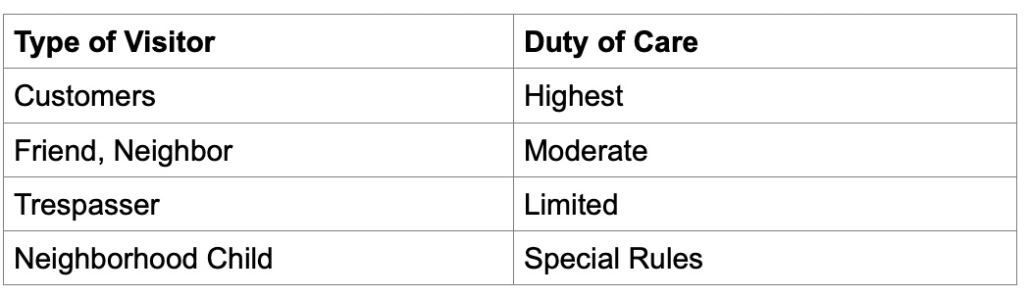
The possessor of land – whether an owner, lessee, or lawful occupant – owes specific duties of care to visitors, based on the visitor’s status (invitee, licensee, or trespasser).
The possessor of the property is not always the property owner. A farm tenant or an independent contractor performing work on the property can be the possessor, if that party has control over the property where the injury occurred. If more than one party has control of the property, the law allocates liability between the several parties.
Types of Visitors and Duty of Care:
- Trespassers: A person who enters the property without permission and you may not know they are there.
Duty of care: You must refrain from willful/wanton conduct which could result in injury of such persons. See additional provisions noted in The Michigan Trespass Liability Act of 2014 section (above). - Licensee: A person who is on the premises with permission, such as friends and family or someone given permission for their own benefit, such as for permission to camp, fish or hunt on the land.
Duty of care: You must refrain from willful/wanton conduct which could result in injury of the person and also must warn them of hidden dangers. Warnings can be made in the form of verbal instructions, written instructions, maps, signs, or by roping or blocking off the dangerous area. The possessor should ensure that the warning method used clearly identifies the danger. Once the level of duty is fulfilled, the visitor assumes the risk of liability. - Invitee: A person who enters the property for business purposes, such as employee, customers, delivery persons, etc.
Duty of care: You must make your premises reasonably safe. If you can’t fix something, you must warn visitors of any impending dangers. Warnings can be made in the form of verbal instructions, written instructions, maps, signs, or by roping or blocking off the dangerous area. The possessor should ensure that the warning method used clearly identifies the danger. Once the level of duty is fulfilled, the visitor assumes the risk of liability. - Child trespassers: A child who enters the property without permission and you may not know they are there.
Duty of care: See The Michigan Trespass Liability Act of 2014 section (above).
-
- (A) “Attractive Nuisance”. You are required to take common sense steps to prevent children from being attracted to your premises (lock doors, keep tractors away from the road, etc.). An attractive nuisance is an artificial condition that attracts a child but which the child doesn’t recognize as dangerous, such as a swimming pool or hay bales that look fun for climbing.
- (B) The “dangerous instrumentality” exception. The “dangerous instrumentality” rule provides that a possessor can be liable for harm to a trespassing child if the possessor creates an actively dangerous situation on the property in an area where children are known to trespass. Conditions for liability are the possessor actively and negligently operates a dangerous apparatus on the property (like leaves a tractor running), and the presence of the trespassing child is foreseeable.
Note that the status of visitor may change at any time, for example, they may come to the farm as an invitee for a specific purpose that you’ve given them permission for, like fishing. If they enter another area of the property that you did not give them permission to enter, they become a trespasser. If you accept payment from a licensee, they are now an invitee. Be aware that your duty of care changes in these situations.
If a visitor goes beyond the scope of the invitation or permission, the possessor is generally not liable for resulting injury. For example, if a farm market customer enters a door that is posted “Keep Out – Personnel Only” and is then injured in the restricted area, the possessor is not liable. Also, the law does not impose liability on the possessor if a visitor is aware of the risks but voluntarily chooses to ignore them. Sometimes, a visitor’s own negligent acts cause or contribute to the injury.
Civil litigation for injuries to a property visitor usually revolves around a claim of “negligence” against the farmer. Negligence actions require the visitor to prove that the farmer breached his or her duty of care to the visitor and that the breach caused the visitor’s injuries.
Sources: Adapted from the National Agricultural Law Center, Ohio State University Extension and Rutgers University
This simple table helps understand where the highest level of care needs to occur:
Open and Obvious Doctrine
Prior to 2023, a core legal principle in Michigan was the Open and Obvious Doctrine, which limited a property owner’s duty to warn about dangers that a reasonable person would readily observe, a common aspect of working farms. Examples – a large, visible hole or an obvious wet floor. This doctrine was eliminated by the Michigan Supreme Court in 2023. The Michigan Alliance for Legal Reform is working for a return to the Open and Obvious Doctrine (Michigan Farm News, 2026) and on March 11, 2026, House Bill 4582 was passed. This bill aims to codify in state law the long-standing “open and obvious” doctrine that protected property owners from liability for hazards that are clearly visible. The bill has advanced to the Michigan Senate for consideration.
Limited Liability Statutes
More than half of the states in the U.S. have limited liability statutes, which typically cover “inherent risks” (like animal behavior, machinery) unless agritourism operators show gross negligence or failure to warn or guard against dangerous conditions. Generally, these laws require that large signs must be posted on the property with very specific language to warn guests about potential risks on the farm. Each state’s statues are different, and some provide a better level of protection than others. Although not perfect, these statutes provide an additional layer of protection for agritourism farms. Sometimes these laws give farmers a false sense of protection, making them less diligent in risk management practices, which most likely will void the protection that these laws provide.
Presently (2026), Michigan does not have a limited liability law, although Michigan Agritourism is actively advocating for a statute to protect agritourism farms.
To date, there is no single federal agritourism liability law in the U.S. Federal efforts, like the proposed Agritourism Act (H.R. 3470 in 2025), aim to promote the sector but haven’t become law.
Descriptions of Warnings
There are multiple ways to warn guests about hazards on the farm and to control your liability.
Notices and Liability Waivers. Liability waiver, a document that visitors sign before entering the farm or engaging in an agritourism activity, is an option for some agritourism venues. The farm guest “agrees to indemnify and hold harmless the landowner from any claims made by the user or third parties arising from the use of the land or activities.” Forms found online may be easy and inexpensive but may not account for the unique requirements of Michigan laws.
Waivers do not remove the landowner’s responsibility for the safety of the farm visitors. Under Michigan law, claims of gross negligence and willful and wanton misconduct cannot be released away. But claims of ordinary negligence usually can be released if the document was properly worded and properly signed (Foster Swift, 2020).
Waivers are viewed as a legal document. Courts in Michigan have shown a willingness to enforce liability releases where properly written and signed, and several court rulings exist that have dismissed lawsuits on the strength of these documents. It is best considered as another layer of protection for your farm but does not substitute for a good insurance policy.
Posted Rules and Warnings. Posting rules and warning regarding known safety hazards can help reduce liability though people might deny seeing posted signs. Examples – no consumption of alcoholic beverages allowed / No smoking on farm / This is a working farm / Caution: electric fence / No swimming in lake / Do not touch animals – they may bite. Talk with your insurance agent about the types of signage that may be best for your farm.
Source: Adapted from Rutgers University Extension
SUMMARY
Concerns about liability risk can be overwhelming. It’s important to secure a good insurance agent who can help you through this process. Educate yourself on Michigan laws, so you understand your legal obligations and be sure to do your “due diligence” by being proactive to mitigate risks on your property. All of these things will help protect your operation and give you peace of mind as you welcome visitors to your farm.
Be sure to review Module 65: Safety and Risk Management for information about managing liability risk at your farm.
MUST READ ARTICLES
The New Cash Crop: Can Agritourism Save the American Farm?
https://www.liveinsurancenews.com/agritourism-save-american-farm/8569717/
The growth in agritourism is growing the need for agritourism insurance. Welcoming the public means the standard farm policy just won’t cut it anymore and the exposures multiply instantly. This article discusses the need for insurance and what insurers want to see in agritourism operations before they underwrite insurance.
Reconsider agritourism for insurance purposes
https://www.farmprogress.com/farm-business/reconsider-agritourism-for-insurance-purposes
Is your farm a safe place for visitors? Consider all risks when opening the door to your farm. This article discusses insurance coverage and ways to minimize risk.
‘Unbelievable’ support floods in after central Ohio family loses farm market to fire
https://www.dispatch.com/story/lifestyle/kindness/2025/10/01/legend-hills-orchard-receives-outpouring-of-support-after-fire/86427168007/
A farm family in Ohio lost their farm market to fire and an on-site apartment where the daughter lived. This story is about how customers, the neighboring farming community, and the community in general rallied to support them and gave them hope in this difficult time. It is a reminder of the importance of helping others during tough times.
RESOURCES AND SUPPORT
This module includes a lot of resources available to you which emphasizes how important these topics are to all agritourism operators! Please take a moment to review those most relevant to your agritourism business. Please share them with staff and incorporate them into your training programs. These are presented in alphabetical order.
Agritourism Business Success (numerous articles)
https://www.agritourismsuccess.com/education
This comprehensive website has numerous articles focused solely on agritourism spanning 12 key topic areas. Several are on insurance and liability topics.
- Agritourism Success: How to Minimize Risks, Protect Your Farm, and Keep Visitors Safe
- “How to Write a Risk Management Plan for Your Agritourism Business”
- “Protecting Your Visitors and Your Farm: Agritourism Safety Tips”
- “Agritourism Insurance: What Coverage Do You Need?”
- “Tips for Managing Liability When Hosting Farm Animals”
- “Ensuring Visitor Safety During High-Risk Activities on Your Farm”
- “10 Common Agritourism Safety Hazards and How to Address Them”
- “How to Create a First Aid and Emergency Plan for Your Agritourism Business”
- “How to Prepare for Weather-Related Risks in Agritourism”
Agritourism Risk Management in this Brand-New Era
https://ccedutchess.org/agriculture/agritourism-risk-management
This resource guide covers a wide range of agritourism risks such as farm safety, marketing, financial, legal, food safety, insurance, and more. Lots of good information!
Cornell Cooperative Extension, Agritourism Fact Sheets Protecting Your Agritourism Operation: Liability and Insurance
https://cornell.box.com/s/56rvu86ctbepnezwv1vbobm8wjdpoi5v
This fact sheet is an overview of key information regarding liability and insurance.
Cornell Cooperative Extension, Agritourism Risk Management Agritourism Risk Management in this Brand-New Era
https://ccedutchess.org/agriculture/agritourism-risk-management
This resource guide covers a wide range of agritourism risks such as farm safety, marketing, financial, legal, food safety, insurance, and more. Lots of good information!
Farm Bureau Financial Services
Find the Right Agritourism Insurance Policy for Your Farm: 5 Questions to Ask
Find the Right Agritourism Insurance Policy for Your Farm: 5 Questions to Ask | Farm Bureau Financial Services
You have crop and farm insurance to protect against crop losses, to cover barns and equipment, and workers compensation insurance to cover staff. But do you have adequate coverage for your agritourism operation? If you open your gates and welcome visitors, agritourism insurance is essential in keeping your farm protected.
Sample Insurance Policy
You will have one or more insurance policies to cover your personal liability, farm liability, and agritourism operations. The policies are broken into various sections, and their arrangement may differ between carriers.
Below is an example of a commercial policy for farms issued by Farm Bureau (Erikson, 2023). This is for illustrative purposes only to show how policies can be customized for agritourism.
Core Sections of a Farm Bureau Policy
A Farm Bureau commercial policy for farms typically combines property and liability coverages (often branded as Member’s Choice or AgMax) into a customizable package. Key sections include Farm Property (dwellings, buildings, equipment), Farm Liability (lawsuits, bodily injury), and specialized coverage for vehicles, livestock, and optional specialized areas like agritourism.
Section 1: Farm Property Coverage. Covers the farm owner’s home (Coverage A), other structures (Coverage B), personal property, machinery, tools, irrigation equipment, and harvested crops. Does not cover migrant or unoccupied housing.
Section 2: Farm Liability Coverage. Protects against legal liability for bodily injury or property damage to others, including farm premises, products, and medical payments. Most claims are found in Coverage E – Bodily Injury and Property Damage Liability.
This section provides additional coverage for agritourism through specialized endorsements added to the base policy to cover increased liability for visitor injuries, property damage, and specialized activities like hayrides, corn mazes, or U-pick operations. While base policies cover farm equipment and property, they often exclude commercial, public-facing activities, making customized, add-on coverage necessary. The premiums are based on the revenue from each type of incidental business. If the area is one that is difficult to insure, Farm Bureau may use a secondary carrier.
Section 3: Farm Personal Property. Covers farm trucks, semis, and specialized vehicles with both liability and physical damage protection. This section contains tractors, UTVs, and ATVs. There are four coverages: farm machinery (H), livestock and poultry (I), harvested crops, feeds, seeds, and fertilizers (J), and miscellaneous farm property (K). Must insure at least 80% of the value. Also need to complete a farm personal inventory (excluding any items you don’t want covered). There are optional endorsements available depending on your operation. For underwriting, farm property should be stored in an insurable building.
Section 4: Farm Buildings. Covers farm buildings, structures, and permanently attached equipment such as milking equipment, fruit and vegetable grading lines and processing equipment, refrigeration equipment, poultry house. This section includes farm markets, shops, and barns.
Ohio State University’s “Agritourism Law Library on the Farm Office”
Taking legal precautions to manage liability risk will help ensure that agritourism remains an important component in agriculture. Though this resource is focused on Ohio, you will also find valuable general liability information. To learn more about legal issues in agritourism, visit OSU’s Agritourism Law Library on the Farm Office website at farmoffice.osu.edu/law-library.
Safeagritourism.org – Insurance Discussion Sheet
https:// safeagritourism.org/wp-content/uploads/Insurance-Discussion-Sheet.pdf
Agritourism operators may use this checklist as a tool to make sure that common insurance questions are answered, or at least considered, in the planning process. The list is not exclusive but serves as a starting point in considering the types of insurance and how much insurance is necessary for agritourism operations.
DISCLAIMERS
The information provided in this online module is for informational and educational purposes only. It is not intended as professional advice and should not be relied upon as such. While efforts have been made to ensure accurate and up-to-date information, we cannot guarantee its reliability or completeness. Readers are encouraged to do their own research and consult with qualified professionals before making any decisions based on the content presented.
References to commercial products, trade names, or suppliers are made with the understanding that no endorsement is implied and that no discrimination against other products or suppliers is intended.
The opinions and advice expressed are solely those of the authors and may not reflect those of the Michigan Agritourism Association, its board of directors, or members. Michigan Agritourism and the authors are not liable for any direct or indirect damage resulting from the use of the information shared with you. Your use of this toolkit indicates your acceptance of these terms.
REFERENCES
eMoney Advisor. (2024, June 10). What role does insurance play in financial planning? https://emoneyadvisor.com/blog/understanding-the-role-of-insurance-in-financial-planning/
Erikson, A. (2023, December 6). Insurance and Liability for your Agritourism Farm. Great Lakes Expo, Grand Rapids, Michigan, United States of America.
Farm Bureau Financial Services. (2022, June 7). Find the right agritourism insurance policy for your farm: 5 questions to ask. https://www.fbfs.com/learning-center/farm-insurance
Farrar, L. (2024, October 31). Trichinosis or treat: Liability laws for pumpkin patches and agritourism a mixed bag. Arkansas Times. https://arktimes.com/arkansas-blog/2024/10/31/trichinosis-or-treat-liability-laws-for-pumpkin-patches-and-agritourism-a-mixed-bag
Foster Swift Collins & Smith PC. (2020, March 31). Liability releases for agritourism activities – Don’t fall prey to myths. Foster Swift Collins & Smith PC. https://www.fosterswift.com/newsroom/publications/Liability-Releases-Agritourism-
Gray, K. (2025, June 24). Farm Bureau supports agritourism operations. Ohio Farm Bureau. https://ofbf.org/2025/06/24/farm-bureau-supports-agritourism-operations/
Gruber, P. (2025a, October 31). Are Ohio’s agritourism rules too loose? Lancaster Farming. https://www.lancasterfarming.com/farming-news/ag-business/are-ohios-agritourism-rules-too-loose/article_2762d349-48ed-4267-8827-0e498ca6c91c.html
Hall, P. (2024c, May 10). Now is the time for agritourism liability risk management – Morning AG clips. Morning Ag Clips. https://www.morningagclips.com/now-is-the-time-for-agritourism-liability-risk-management/
Jiao, H. (2022, February 14). Defining the bounds of booming agritourism. Farmdoc Daily. https://farmdocdaily.illinois.edu/2022/02/defining-the-bounds-of-booming-agritourism.html
Kaplan, J. (2024, October 15). Few state regulations in place for fall agritourism businesses in Minnesota. CBS News. https://www.cbsnews.com/minnesota/news/minnesota-fall-agritourism-businesses-regulations/
Michigan Farm Bureau releases 2026 policy book (2026, February 2). Michigan Farm Bureau Family of Companies. https://www.michfb.com/about/news-media/michigan-farm-bureau-releases-2026-policy-book#:~:text=Michigan%20Farm%20Bureau’s%202026%20Policy,together%20in%20the%20year%20ahead.%E2%80%9D
Michigan Farm News. (2026, January 19). https://www.michiganfarmnews.com/farm-bureau-joins-michigan-alliance-for-legal-reform-to-defend-farm-based-businesses
Owens, R. (2025, September 26). Risk Management and Insurance – Cornell Small Farms. Cornell Small Farms. https://smallfarms.cornell.edu/guide/guide-to-urban-farming/risk-management-and-insurance/#risk-management-for-farmers
Pashow, L. (2024, June 25). Protecting Your Agritourism Operation: Liability and Insurance (#3). Agritourism Fact Sheets. Cornell Cooperative Extension. https://cornell.app.box.com/s/56rvu86ctbepnezwv1vbobm8wjdpoi5v/file/1571219104279
Shilling, B. et al. (2017). FS1265: Managing Liability on Agritourism Farms (Rutgers NJAES). https://njaes.rutgers.edu/fs1265/
University of Connecticut Extension. (2025, January 30.). Agritourism: Harvesting Prosperity. In cahnr.uconn.edu/extension/. Zoom Meeting, United States of America. https://uconn-edu.zoom.us/j/98264018223?pwd=ibJKCDfdlW74aUV128GSuz6IGCkTtK.1
Walztoni, E. (2024, September 2). Selling eggs at the end of your driveway? You may want insurance. Bangor Daily News. https://www.bangordailynews.com/2024/09/02/homestead/farm-life/maine-farmers-liability-insurance-joam40zk0w/