
Michigan Building Construction Code
We encourage you to visit the sections most relevant to you using the hyperlinks below.
Introduction
Michigan’s Building Construction Code
Agricultural Exemption
Compliance
Modifying An Existing Structure
Frequently Asked Questions
Key Definitions
What Type Of Building Are You Planning
Must Read Articles
Resources And Support
Disclaimers
References
Key Take Aways
Understanding Michigan’s zoning laws and building codes is essential to the success of any construction or renovation project. These regulations are in place to ensure that buildings are safe, functional, and compatible with the surrounding environment.
If a structure is used only for farming activities, such as a barn, it may be exempt from building permits and certain code requirements.
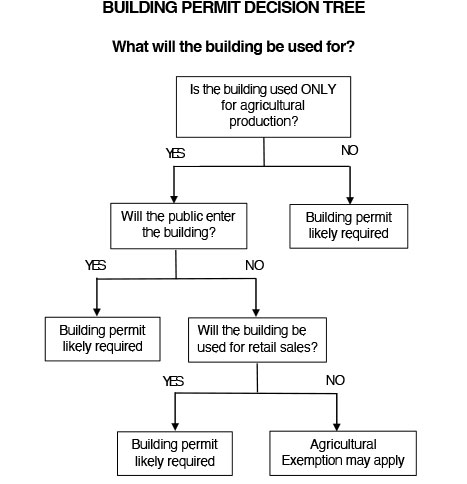
Buildings that are used in the business of retail trade (to sell products to the public and are open to visitors) are typically NOT exempt and must meet Michigan’s building codes and require permits.
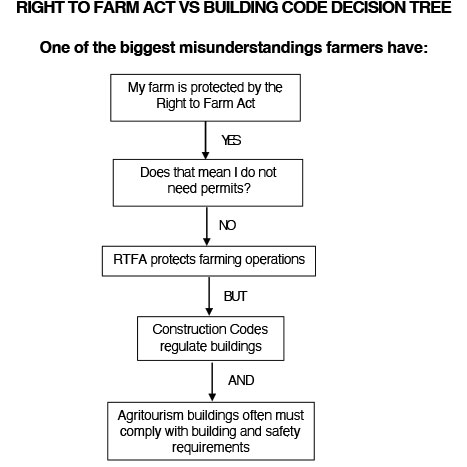
The Right to Farm Act protects agricultural operations from nuisance claims and some zoning restrictions, but it does not create a blanket exemption from Michigan’s construction and safety laws. Those exemptions often disappear when buildings are used for agritourism, retail, or public events.
Agritourism venues often require permits for electrical, plumbing, or structural changes to accommodate public safety. Do your research before building to make sure you know what rules to follow. Talk to your township up front during planning.
When renovating an existing farm building in Michigan, the compliance requirements depend on whether the building’s use remains strictly agricultural or transitions to a different purpose. If your building had an agricultural exemption and the renovation transforms it into a space for the public or commercial activity, you lose the agricultural exemption and must comply with the Michigan Rehabilitation Code. If your building requires a permit, it must meet the Michigan Building Code standards for its new use.
INTRODUCTION
Agricultural Buildings are an essential element of any farming operation. Buildings are needed to store farm equipment and produce, process farm products and other farming-related activities. Other types of buildings are needed for public-related activities, such as retail sales, hosting events, animal viewing, etc. Sometimes a building will have mixed usage, storing equipment in the winter, but used for U-pick operations during the fruit season. Before constructing or renovating a building on your farm, it’s important to know that the regulations vary depending on the intended use of the building, as well as township rules and regulations.
Buildings solely used for agriculture purposes are exempt from some regulations, whereas buildings intended for public use must comply with a variety of regulations. It can often be confusing, especially when a building has multiple uses, so it’s important to do your research before you begin any building or renovation project at your farm and touch base with your local planning commission.
Five important things to know:
- Agricultural buildings may be exempt.
- Retail buildings usually are not exempt.
- Public-use buildings usually are not exempt.
- The Right to Farm Act does not exempt you from building codes.
- Always talk to your township and building department before constructing or renovating a building on your farm.
MICHIGAN’S BUILDING CONSTRUCTION CODE
What is a Building Construction Code?
Building construction codes are regulations that specify the standards for construction and renovation to ensure the safety, health, and structural integrity of buildings. These codes cover everything from the materials used to the design and structural components of a building.
Michigan’s Building Code
Building permits are how Michigan ensures safe and code-compliant buildings. Michigan adopted a statewide building code and building permits are a requirement of this code. The Stille-Derossett-Hale Single State Construction Code Act 230 of 1972 is the enabling legislation for Michigan’s single, statewide building code.
Most building permits are issued and enforced by local government which helps keep costs down and better serves residents. Complying with these codes is necessary for obtaining building permits and passing inspections.
Michigan Building Code (MBC) is based on national standards like the International Building Code (CMS Specialists, 2025). The MBC outlines requirements for:
- Structural Integrity. Ensuring that the building can withstand various forces, including wind, snow, earthquakes, and human occupancy.
- Safety Measures. Installing proper fire protection, including fire-resistant materials, smoke alarms, sprinklers, and escape routes.
- Energy Efficiency. Following guidelines that improve the energy efficiency of a building, such as insulation standards, lighting requirements, and heating/cooling system efficiency.
- Accessibility. Making sure the building is accessible to everyone, including people with disabilities, by adhering to the Americans with Disabilities Act (ADA) standards.
- Plumbing and Electrical Systems. Installing plumbing and electrical systems that are safe, reliable, and up to code, including requirements for plumbing fixtures, wiring, and energy-efficient systems.
Most of these projects require specific items for code compliance and therefore a permit and inspections are required. For some projects which do not require a building permit, such as sheds, fences, and agricultural buildings, it still may be necessary to obtain a permit for zoning compliance.
Updates. The codes were updated in 2021, and codes for commercial/larger projects became effective in April 2025. The main updates were in the areas of electrical, rehabilitation, and energy standards. Check with your local township, city or county building department for specific enforcement dates and additional updates.
AGRICULTURAL EXEMPTION
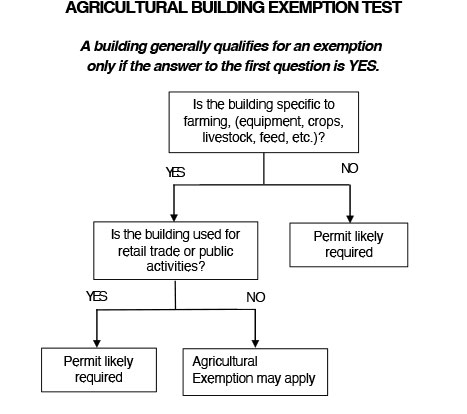
The Michigan Construction Code includes a provision which exempts “a building incidental to the use for agricultural purposes of the land on which the building is located” from the construction code and building permit requirements.
These buildings are strictly used for agricultural purposes and not in retail trade or open to the public. Buildings such as barns, grain storage, hay storage, and livestock shelters may not require a building permit.
To qualify for the exemption, the building cannot be used for:
- Retail Trade. Any building used for commercial sales (except certain roadside stands) must comply with the code.
- Human Habitation. Residential dwellings on farm property always require full permits.
- Public Access. Structures open to the public, such as wedding venues or haunted barns, are subject to local regulation and all applicable building codes.
- Processing. Places where agricultural products are processed, treated, or packaged are generally not exempt
Detached agricultural accessory buildings may not need a permit, but many townships require an affidavit attesting to agricultural use. Even if exempt from a building permit, structures must often comply with local zoning, setbacks, and sometimes the Michigan Residential Code for specific structures like decks or porches.
Sources: Clifford H. Bloom and Bloom Sluggett Morgan, PC, and Mika Meyers (law firm)
When the Exemption Does Not Apply
Farm markets and other commercial-use buildings used to sell products to the public, host events and/or that are otherwise open to visitors, are typically not exempt and must meet the full Michigan Construction Code (including safety, structural, accessibility, and fire standards). These buildings often require permits for electrical, plumbing, or structural changes to accommodate public safety. Even if these buildings are located on a farm, they must comply with the Construction Code Act. This includes buildings that are multi-use depending on the season such as hosting breakfasts for customers during u-pick season and storing field equipment during the winter.
Contact your local township or county building department to confirm that your building qualifies for an exemption.
BUILDING PERMITS
Purpose of Permits
Permits help to ensure the quality of the building and you must apply for building permits before starting your project. If work on a building is done improperly or without a permit, the township may be forced to have the project repaired or even torn down and may close the business until this is completed. Additionally, insurance companies may not insure building work done without a permit or proper inspections.
Permits are issued once your plans are reviewed and deemed to meet Michigan’s building code requirements. After construction begins, building inspections are scheduled at various stages to ensure compliance with building codes.
To comply with the state construction laws, it is mandatory that permits be issued and inspections be carried out.
When a Building Permit is Required
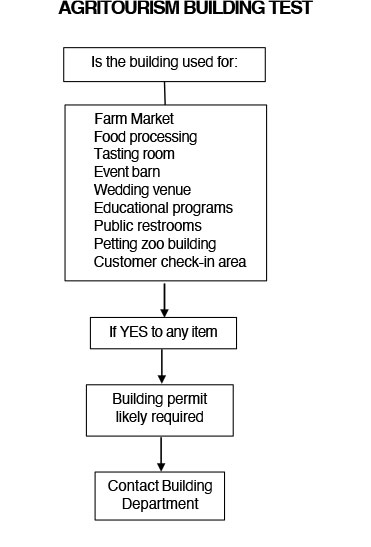
A building permit is generally required for structures used for public or commercial purposes (e.g., selling produce or hosting guests). Permits are required for most new construction as well as renovations or changes in use. Some building permits may be harder to acquire if they could potentially be opposed by residents nearby or by those who might be affected by the build.
The following “Decision Trees” will help you determine if you need a building permit:
Land Use Permits
If your proposed building is for agricultural use only, such as a pole barn used for farm purposes like housing livestock, storing equipment, or sheltering feed, you may qualify for exemptions. In many Michigan counties, agricultural buildings only need a land use permit. Be sure to:
- Verify with your local zoning office
- Submit a basic description of the structure and intended use
- Stay within standard setback limits
COMPLIANCE
Compliance with the permitting process is not optional. It is an essential part of operating an agritourism business.
The Compliance Checklist
Before Construction:
- Identify intended use
- Check zoning
- Contact building department
- Determine exemption status
- Obtain permits
- Schedule inspections
- Obtain Certificate of Occupancy
Lack of Permit. If the Building Department discovers a project that has been started without a permit, they will attempt to contact the homeowner, contractor or person in charge, in writing, that a permit is required for their project. If the required permit is not applied for by the deadline, the owners of the project may risk a “stop work order”, civil citations, and/or prosecution.
Pulling a Permit. If a contractor is performing the work on your project, the permits should be pulled by the contractor. Whoever signs the permit is responsible for the project to be completed properly and up to code. The permit fees for contractors and property owners are the same.
Building Inspections
Local building officials typically enforce these standards during plan review and project inspections. The typical inspection process includes:
- Checking the foundation (footings) before posts are set
- Inspecting the framing for galvanized nails, proper spacing, and header strength
- Inspecting various trades upon their completion
- A final walkthrough before completion
Failure to have the required inspections will delay the issuance of the final approval and the “Certificate of Occupancy”. Many financial institutions and insurance companies require a Certificate of Occupancy prior to closing or insuring. A Certificate of Occupancy is issued after all the trades in the building project have had final approval.
Builder’s Checklist, Example (Branch County Building Department)
Branch County has an online Builder’s Checklist that lists the information and documentation their residents need to be able to apply for building permits. Though specific to that municipality, it may give you an idea of what may be needed in your jurisdiction. Always be sure to check with the local zoning department in your township before beginning a project.
Work with the Building Department
Be sure to get the proper permits and have the required inspections performed, including the final inspection. If permits are not obtained, or inspections and a final inspection are not performed, the building department may assess additional fees or fines.
If you are in doubt about needing a permit, check with the local building department, prior to beginning your project. Get the building department involved with your project, they are there to support you and make the process easier!
Sources: Branch County Department, Erie Township Building Department, CMS Specialists
MODIFYING AN EXISTING STRUCTURE
Renovations and Change of Use
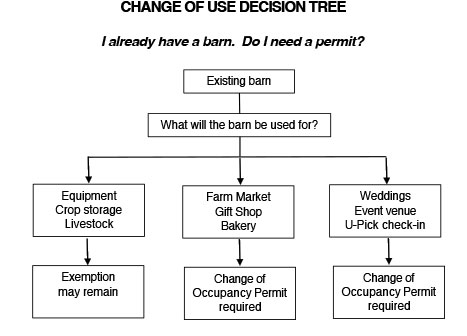
Not all buildings are newly constructed. When renovating an existing farm building in Michigan, the compliance requirements depend entirely on whether the building’s use remains strictly agricultural or transitions to a different purpose.
Maintaining an Agricultural Exemption
If you are repairing or altering a structure to continue using it for “agricultural purposes” (e.g., housing livestock, storing farm equipment, or crops), you generally remain exempt from building permit requirements under the Stille-DeRossett-Hale Act. However, your local municipality may still require you to file an Agricultural Exemption Affidavit to document that the renovation does not change the building’s exempt status. While the structure itself may be exempt, any new electrical or plumbing installations typically must still follow the state’s respective codes and require separate trade permits.
Renovating a Structure. If you are renovating a barn or other structure into a space for the public or commercial activity, you lose the agricultural exemption and must comply with the Michigan Rehabilitation Code. Examples:
- Farm Markets/Retail. Any building used for retail trade must comply with standard building codes.
- Agritourism. Converting a barn into an educational space, event venue, or tasting room, requires a “Change of Occupancy” permit.
- Commercial Processing. Buildings used for commercial storage, processing, or distribution are generally not considered “qualified agricultural property” for code exemptions.
Example: Creating a Farm Market and Event Space
For example, if you want to convert an old barn into a farm market and use part of it for special events, you need to know the following:
- According to the Farm Market GAAMPs, if 50% of your sales are farm-produced, then local zoning cannot prohibit the farm market.
- You may need a Special Land Use Permit from your local planning commission to use the barn for special events.
- You need to follow your local townships parking, setbacks and signage rules. While the GAAMPs allow for grass or gravel parking for markets, local zoning may require paved or specifically designed parking for large event crowds, needed for special event activities.
- Combining a farm market with a space for public events means the building must meet the most stringent requirements of both uses. This dual-use status triggers a full “Change of Occupancy,” requiring the structure to comply with the Michigan Building Code as a commercial facility.
You will need to address:
- Architect/Engineer Seal. Michigan law requires that all construction documents for commercial renovations be signed and sealed by a licensed architect or engineer.
- Fire Suppression. “Assembly” uses often trigger the need for automatic sprinkler systems and fire alarms, especially if the occupant load is high or the building is large.
- Barrier-Free Access. The building must meet ADA standards, including accessible entrances, interior routes, and compliant restrooms.
- Egress (Exits). You must have enough exits (with panic hardware) to allow all occupants to leave safely during an emergency.
Before beginning work, permits you will typically need:
- Commercial Building Permit. Accompanied by sealed blueprints.
- Trade Permits. Electrical, mechanical, and plumbing (required even if the building was previously exempt).
- Soil Erosion Permit (SESC). If the renovation involves disturbing soil within 500 feet of a water body.
- Health Department Review. For the type of water you will be using and restroom facilities.
- MDARD Bureau of Food Safety and Animal Health: If you plan to process or serve food.
Depending on the nature and location of a farm market operation, other local, state and/or federal regulations may still apply. It is the responsibility of the farm market owner or their representative acting on the owner’s behalf to contact the appropriate regulatory authorities to determine if additional permits for compliance are required prior to beginning any activity or construction.
FREQUENTLY ASKED QUESTIONS
Does RTFA exempt me from building permits? It depends on how the building is used. RTFA protects farming operations, but the Michigan Construction Code regulates buildings. Agritourism buildings often must comply with building and safety requirements. If the building is solely used for agricultural purposes, it may be exempt from the Construction Code and building permit requirements.
Is a farm market exempt from building permits? No. If the public is entering the building, a building permit is required and must comply with the Construction Code.
What about a roadside stand? A roadside stand is not exempt from obtaining a building permit, but it is exempt for the plumbing fixture requirements and is not required to have electric power if it is a “qualifying roadside stand.” If it does have electric power, it must comply with the electrical code. (MCL 125.1510(9))
A “qualifying roadside stand” means a roadside stand that meets all of the following requirements:
- It is used only for seasonal retail trade in agricultural products.
- At least 50% of the agricultural products offered for sale at the roadside stand are produced on a farm that is owned or controlled by the person who owns the roadside stand.
- Is not larger than 400 square feet.
- Is securely anchored to the ground.
MCL 125.1510 (10) exempts a tent that meets the requirements of a “qualifying roadside stand” above.
What if my barn is used both for farming and agritourism? If the public is coming into the barn at any time of year, it most likely needs to comply with the Building Construction Code and related permits.
Can my township require setbacks, etc.? Yes. You still must comply with local building setback requirements, provide sufficient parking, comply with signage regulations and have ingress and egress approved by MDOT.
Do I need ADA compliance? The Americans with Disabilities Act requires that you make reasonable accommodations for guests with disabilities. https://nationalaglawcenter.org/wp-content/uploads/2025/05/2025-NALC-ADA-Agritourism-Schweichler.pdf
KEY DEFINITIONS
Below is a quick guide to selected key agricultural definitions from Section 125.1502a, Stille-Derossett-Hale Single State Construction Code Act. Please refer to these as needed throughout this module.
“Agricultural or agricultural purposes” means of, or pertaining to, or connected with, or engaged in agriculture or tillage that is characterized by the act or business of cultivating or using land and soil for the production of crops for the use of animals or humans, and includes, but is not limited to, purposes related to agriculture, farming, dairying, pasturage, horticulture, floriculture, viticulture, and animal and poultry husbandry.
“Agricultural product” means a farm product as defined in section 2 of the Michigan right to farm act, 1981 PA 93, MCL 286.472.
“Barrier free design” means design complying with legal requirements for architectural designs that eliminate the type of barriers and hindrances that deter persons with disabilities from having access to and free mobility in and around a building or structure.
“Building” means a combination of materials, whether portable or fixed, forming a structure affording a facility or shelter for use or occupancy by individuals, animals, or property. Building does not include a building, whether temporary or permanent, incidental to the use for agricultural purposes of the land on which the building is located if it is not used in the business of retail trade. Building includes a part or parts of the building and all equipment in the building unless the context clearly requires a different meaning.
“Construction” means the construction, erection, reconstruction, alteration, conversion, demolition, repair, moving, or equipping of buildings or structures.
“Construction regulation” means a law, act, rule, regulation, or code, general or special, or a compilation thereof, enacted or adopted by this state including a department, board, bureau, commission, or other agency of this state, relating to the design, construction, or use of and the installation of equipment in buildings and structures. Construction regulation does not include a zoning ordinance or rule issued pursuant to a zoning ordinance and related to zoning.
“Enforcing agency” means the governmental agency that, in accordance with section 8a or 8b, is responsible for administration and enforcement of the code within a governmental subdivision. However, for the purposes of section 19, enforcing agency means the agency in a governmental unit principally responsible for the administration and enforcement of applicable construction regulations.
“Equipment” means plumbing, heating, electrical, ventilating, HVAC and related equipment, hoods and fire suppression equipment.
“Structure” means that which is built or constructed, an edifice or building of any kind, or a piece of work artificially built up or composed of parts joined together in some definite manner. Structure does not include a structure incident to the use for agricultural purposes of the land on which the structure is located and does not include works of heavy civil construction including, but not limited to, a highway, bridge, dam, reservoir, lock, mine, harbor, dockside port facility, an airport landing facility and facilities for the generation, transmission, or distribution of electricity. Structure includes a part or parts of the structure and all equipment in the structure unless the context clearly requires a different meaning.
WHAT KIND OF BUILDING ARE YOU PLANNING?
Agricultural Buildings
Examples:
- Barn-Pole barn
- Maintenance
- Machinery storage
- Livestock building
- Produce storage
Retail Buildings
Examples:
- Farm market
- Bakery
- Gift shop
Mixed-Use Buildings
Examples:
- quipment storage in winter
- U-pick check-in during season
Building Permit Requirement examples:
Building Use
Equipment storage
Livestock housing
Farm market
Event venue
Tasting room
Cafe
Gift Shop
U-pick check-in building
Permit Required?
Usually No
Usually No
Yes
Yes
Yes
Yes
Yes
Usually Yes
MUST READ ARTICLES
Michigan Right to Farm Act Basics
https://www.mikameyers.com/right-to-farm-act-basics/
This informative article, written by a law firm, discusses how Michigan’s Right to Farm Act and the Generally Accepted Agricultural and Management Practices (GAAMPS) can preempt local ordinances. The most common areas where this occurs are farm animals and farm markets.
RESOURCES AND SUPPORT
Below are resources you may find helpful on building construction in Michigan. Please review them for more information.
Branch County Building Department, Forms & Resources
https://branchcounty.gov/departments/building/forms-resources/
Though specific to Branch County, they offer online resources and checklists. These are provided for illustrative purposes only. Please check your local county or township for forms and information specific to your geographic area.
Building Permit Exemption
https://www.michfb.com/agriculture/farming-resources/land-use-regulation/building-permit-exemption
This resource from the Michigan Farm Bureau Family of Companies provides answers to the most commonly asked questions they receive regarding building permit exemptions.
Building Permits in Michigan:
https://www.michigan.gov/lara/bureau-list/bcc/sections/permit-section/permits/building-permit-information
Information from the Michigan Department of Licensing and Regulatory Affairs regarding building permits. Includes: general information on building permits, building permit application, what documentation is required, and location of building inspectors statewide.
Farm Buildings
https://www.michigan.gov/-/media/Project/Websites/treasury/TAB/Vol113FarmBuildingsDefinitionsTableofContents.pdf?rev=1089bf4cb0a547f38d4a065c03b660aa
This resource contains cost data for agricultural buildings and other structures and for equipment most commonly found on farms. Cost information is often needed for building permits. Each page contains written specifications showing the structural components used to calculate the base building cost, shown in tables as dollars for the entire structure or as costs per square foot. Adjustment tables are provided so allowances can be made when a structure’s components vary from those specified. Some pages also provide costs of equipment that might be associated with the structure described on that page. It also contains the Class of Construction, the basic subdivision in the Michigan Assessor’s Manual. The Class divides all buildings into four basic cost groups by type of framing (supporting columns and beams), walls, floors and roof structures.
Generally Accepted Agricultural and Management Practices for Farm Markets, 2025
https://www.michigan.gov/mdard/-/media/Project/Websites/mdard/documents/environment/rtf/2025-GAAMPs/Farm-Markets-2025-GAAMPs.pdf?rev=39cb636cdbc847bdaa372ab2f5701e4b&hash=AAC11B551CD16F58C88191FB5D55E861
These practices are written to provide uniform, statewide standards and acceptable management practices for building and maintaining a farm market.
Land Use & Regulation
https://www.michfb.com/agriculture/farming-resources/land-use-regulation
The Michigan Farm Bureau Family of Companies website offers resources, sample documents, and guidance on land usage, including building permit exceptions along with guidance to help you make the most of your land.
Michigan Building Code, Part 4
https://www.michigan.gov/lara/-/media/Project/Websites/lara/bcc-media/ASD/Current-Rules-Building-2025/202548-LR-Part-4-Building-StrikeBold–11242025.pdf
These are the rules for Michigan’s Building Code.
Michigan Pole Barn Laws: What You Should Know Before You Build
https://custompolebarnpackages.com/blog/michigan-pole-barn-laws/#:~:text=Residential%20pole%20barns%20are%20typically,must%20still%20follow%20zoning%20rules
Whether it’s a garage, livestock shelter, or storage structure, the laws that guide construction in Michigan can make or break your project. Between zoning permits, building codes, and footing requirements, it’s important to understand what’s required before you break ground on your new pole barn.
Michigan Rehabilitation Code 2021, Chapter 10
https://up.codes/viewer/michigan/mi-rehabilitation-code-2021/chapter/10/change-of-occupancy#10
This resource provides regulations for the circumstances where an existing building is subject to a change of occupancy or a change of occupancy classification. If the project requires a permit, it must meet the Michigan Building Code standards for its new use.
Stille-Derossett-Hale Single State Construction Code Act 230 of 1972
https://www.legislature.mi.gov/Laws/MCL?objectName=mcl-Act-230-of-1972
This is the full act, including agricultural definitions, for Michigan’s single, statewide building code.
What You Need to Know About Zoning Laws and Building Codes in Michigan
https://cmsmaterialsolutions.com/blogs/news/what-you-need-to-know-about-zoning-laws-and-building-codes-in-michigan?_pos=1&_sid=b8d796dd1&_ss=r
When embarking on a new construction project or renovating an existing property in Michigan, understanding zoning laws and building codes is crucial. This article summarizes the key information for someone considering building in Michigan.
DISCLAIMERS
The information provided in this online module is for informational and educational purposes only. It is not intended as professional advice and should not be relied upon as such. While efforts have been made to ensure accurate and up-to-date information, we cannot guarantee its reliability or completeness. Readers are encouraged to do their own research and consult with qualified professionals before making any decisions based on the content presented.
References to commercial products, trade names, or suppliers are made with the understanding that no endorsement is implied and that no discrimination against other products or suppliers is intended.
The opinions and advice expressed are solely those of the authors and may not reflect those of the Michigan Agritourism Association, its board of directors, or members. Michigan Agritourism and the authors are not liable for any direct or indirect damage resulting from the use of the information shared with you. Your use of this toolkit indicates your acceptance of these terms.
REFERENCES
Building permit exemption | Michigan Farm Bureau Family of companies. (n.d.). Michigan Farm Bureau Family of Companies. https://www.michfb.com/agriculture/farming-resources/land-use-regulation/building-permit-exemption
CMS Specialists. (2025, April 16). What you need to know about zoning laws and building codes in Michigan. CMS. https://cmsmaterialsolutions.com/blogs/news/what-you-need-to-know-about-zoning-laws-and-building-codes-in-michigan?_pos=1&_sid=b8d796dd1&_ss=r
Glenn, A. (2023, May 9). Michigan Right to Farm act Basics. Mika Meyers. https://www.mikameyers.com/right-to-farm-act-basics/
Joeseph. (2025, May 21). Michigan Pole Barn Laws: What you should know before you build. Custom Pole Barn Packages LLC. https://custompolebarnpackages.com/blog/michigan-pole-barn-laws/#:~:text=Residential%20pole%20barns%20are%20typically,must%20still%20follow%20zoning%20rules
MCL – Section 125.1502A – Michigan Legislature. (n.d.-b). https://www.legislature.mi.gov/Laws/MCL?objectName=mcl-125-1502a
Michigan Commission of Agriculture & Rural Development. (2025). Generally accepted agricultural and management practices for farm markets. https://www.michigan.gov/mdard/-/media/Project/Websites/mdard/documents/environment/rtf/2025-GAAMPs/Farm-Markets-2025-GAAMPs.pdf?rev=39cb636cdbc847bdaa372ab2f5701e4b&hash=AAC11B551CD16F58C88191FB5D55E861
Schmidt, C., Entsminger, J.S., Cornelisse, S. and Schweichler, J. (2025) “Insights on Agritourism Among U.S. Producers: Evidence from the 2024 National Agritourism Producer Survey.” Data Brief 2025-1. Northeast Regional Center for Rural Development.
When do you need a permit? (2022, May-b). https://erietownshipmi.gov/wp-content/uploads/2022/05/When-Do-You-Need-A-Permit.pdf